
Which Sector? Why Workforce Development Should Drive Sector Prioritisation
What you already have as a workforce is largely what you will have over the short to medium term.
That simple fact is missing from most conversations about sector prioritisation in regional economic development — and it is the starting point for how Ascham Grindal approaches the problem.
Reindustrialisation, local economic growth and industrial policy are all high on the agenda for local and regional strategic authorities. But the fundamental challenges remain the same: low productivity, skills gaps, labour mismatches, and a persistent shortage of capital, investment and infrastructure. The national industrial strategy's eight priority sectors (IS-8) give a valuable foundation for regional and local areas to align policy — but there is a legacy problem of non-priority sectors still needing to be accommodated, and a live risk that every region claims the same handful of “strengths.”
The real unresolved problem is how local areas decide which sectors to prioritise, given that there is not enough resource for every sector, every programme or every opportunity.
This is one of the problems I set up Ascham Grindal to work on. There are plenty of ways to approach sector prioritisation — mapping firms, sectors and inward investment among them — but one that remains underdeveloped in the UK is basing it on workforce development.
Workforce development: not just skills
Workforce development is about the labour market: the people currently working in your local and regional economy. It is not just about skills — it is about how people are allocated across sectors and, crucially, how easily they can move between jobs and sectors.
Understanding this at a strategic level shapes which sectors you prioritise, how you promote your area for inward investment, how you align your readiness for innovation, and how you commission skills and employment support. Workforce development is, in effect, a route to sector prioritisation — but it needs to be grounded in more than a simple review of the labour market.
One of my constant refrains is that the UK's obsession with skills undermines a lot of what economic development is trying to achieve. I have worked in and around the skills system long enough to know its value to people's lives and opportunities. But the skills system itself is not a strategy for economic development — it is a critical lever that makes economic development happen. The job is not to catalogue skills gaps and mismatches; it is to set a clear strategic view of which sectors are being developed, so the skills system knows what it is being asked to deliver.
That matters because there is not enough resource in the skills system to support every sector equally — whether that is course funding, the capital cost of training facilities, or the availability of teachers and industry connections. A system that tries to ‘do everything for everyone’ misses the chance to use the levers of devolution to create a genuine step change in regional economies. Workforce development, done properly, sets out clearly what colleges, universities and training providers should focus on — and, just as importantly, what should not be a priority, so resources go where they will have the most effect.
Prioritisation in practice
Using workforce development as the baseline for sector prioritisation needs a consistent, repeatable method. At Ascham Grindal, we start with the workforce already in the local and regional economy — because what you already have is largely what you will have over the short to medium term.
Alongside capital and inward investment, the existing workforce is the tangible asset that supports that investment and ensures local areas benefit from it. We start with people because people are the outcome alongside their households, and their wider community.
Any local labour market is a mix of established sectors, new jobs and changing jobs — shifting in response to AI and automation, and to the ordinary churn within sectors as skills priorities and labour demand change. Rachel Lipson's recent work captures this well in a US context, distinguishing three categories of job and the different workforce response each demands [1]:
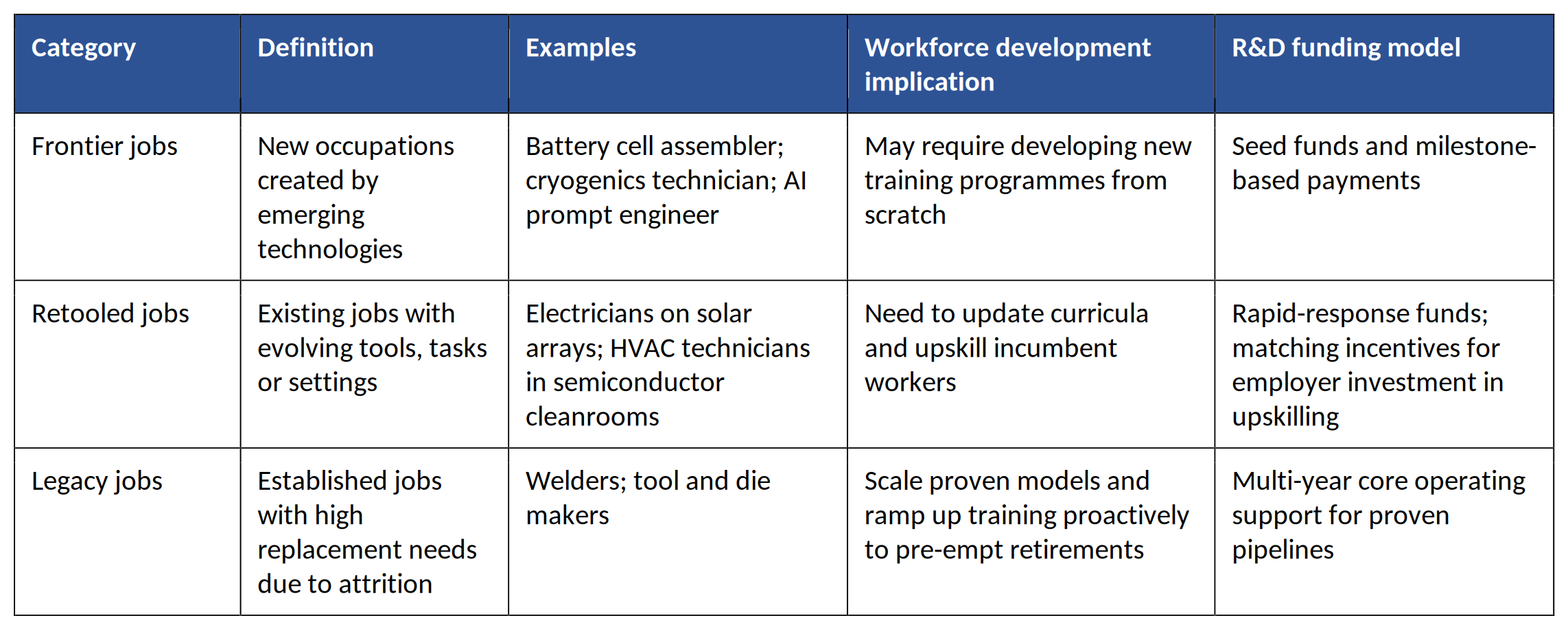
Table from Lipson 2025
We adapt this framework to the UK context and use it to interpret what a region's relatedness scores are telling us: strong relatedness in a legacy occupation points to scaling proven training routes now; a frontier occupation with deliberately low relatedness to the existing workforce signals the kind of seed investment in new training pathways Lipson describes.
The next step is working out how related the skills, knowledge and abilities in the existing workforce are to the occupations a target sector needs. This is where skill relatedness comes in — a well-established idea in regional economic development that measures how far the skills and occupations workers already have transfer into other jobs and roles.
Practically, this means comparing the skill profile of each occupation in a region's current workforce against the skill profile of the occupations in a priority sector depends on a standard method for scoring how alike two skill profiles are, independent of how many people work in either occupation. Weighting those similarity scores by how many people are employed in each occupation locally produces what we call a Skill Relatedness Density (SRD) score for that sector: in plain terms, how much of a head start a region's existing workforce already gives it in a candidate sector.
We use this to produce three levels of output: a broad score reflecting average relatedness across a whole sector; a more specific score based on the top five occupations feeding that sector; and a detailed score built from the full set of skill relatedness densities identified through the UK Standard Skills Classification (SSC). The SSC is still in active development, but the underlying model is built so that it updates as the SSC itself is updated — so the analysis becomes more precise over time rather than needing to be rebuilt.
So what does this let a region do?
Three things: prioritise sectors, align commissioning to those sectors, and clarify place promotion.
Prioritise sectors
One of the biggest challenges made against industrial policy is the poor record of ‘picking winners’, and the pressure on local areas to align their priorities with a national government approach to investment and sectors that can shift.
Starting from a workforce perspective offers a different discussion: if you know how closely related your current workforce is to different sectors, you can have a different conversation with stakeholders about the value of focusing on one or two sectors, specific sub-sectors, or a particular cluster of firms.
This does not mean other sectors or opportunities stop mattering — it means agreeing that, for the resources you have, you can focus on a narrow, specific goal for a defined period around one or two sectors, while continuing to support the rest to a lesser extent. It will not be an easy discussion, but it allows for a rigid focus on how resources are used, while giving sectors clarity about what is being committed to, why, and for what outcome. It sets boundaries and expectations and creates the conditions for integrating the levers needed to deliver growth.
Align commissioning
Once sectors are prioritised, you can align the commissioning of skills, employment and other support so that providers can reasonably commit resources — facilities, teachers, industry partnerships — knowing these are linked back to the region's priorities. This uses the strategic role devolved authorities play in shaping the market for skills and training. It relies on the public sector being able to credibly commit to a course of action, so that everyone can crowd in, confident that policy will not suddenly shift.
Clarify place promotion
With priorities set and commissioning aligned, you can be precise about what you need — and want — from the private sector in terms of investment, FDI and commercial development. If the private sector understands what you are trying to do, with a reasonable level of precision linked to the workforce you actually have, they are more likely to engage in a conversation about their role in providing the investment and infrastructure to make it happen. Place promotion becomes less about listing every asset and opportunity, and more about a clear offer to the market that links back to a single plan.
None of this is easy. It takes a willingness to commit to a course of action and stick with it, and an acceptance that the current system cannot carry on spreading the jam in thinner and thinner layers, hoping for a breakthrough moment. Instead, it means working with what you have, who you have, and the potential for new jobs in the sectors you have chosen to back — and using that as the basis for delivering against the national industrial strategy.
References
[1] Rachel Lipson, America's Missing Productivity Strategy: An R&D Approach to Workforce Development (Aspen Institute, 2025).