
The New UK Standard Skills Classification: Preparing for Transformative Change
The recent publication of Skills England’s interim report on the UK Standard Skills Classification (SSC) marks a pivotal moment for those of us working around labour markets, skills, and economic development. For Ascham Grindal, as a specialist advisory firm, the emergence of the SSC offers both a timely opportunity and a considerable challenge for our clients and partners across investment, development, and the public sector.
What’s Changing?
At this stage, the SSC is still in development, but its significance is already clear.
The framework introduces a balanced approach to classifying occupations and skills, with the welcome addition of ‘occupational knowledge’ as a distinct category. This alignment brings the UK closer to international best practice, drawing on the strengths of established taxonomies such as O*NET, but crucially, the SSC promises a unified framework and a shared language for describing skills, tasks, and knowledge across the UK labour market.
While the implications for the existing Standard Occupational Classification (SOC) remain to be seen, the introduction of the SSC is a major step towards a more coherent and flexible system for understanding workforce capability.
Why Does the SSC Matter?
Skills England’s report outlines several expected use cases for the SSC (see image below), but we see additional strategic opportunities.
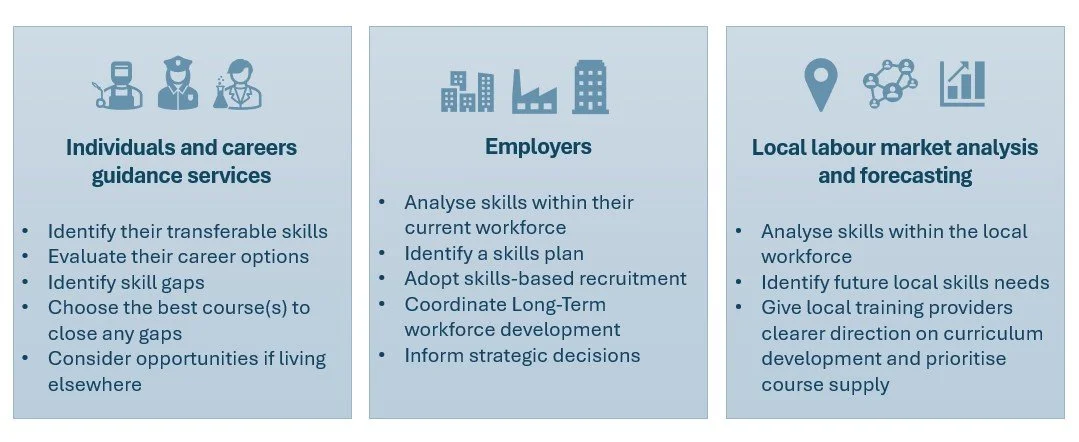
Proposed Use cases for Standard Skills Classification
A persistent challenge in the UK has been linking inward investment strategies to labour market realities. Currently, the dialogue between investors, business leaders, and workforce planners is fragmented and often fails to capture the nuanced blend of skills, tasks, and knowledge required in specific locations.
A robust SSC could enable more effective engagement with investors and employers, allowing for a clearer mapping of workforce capabilities to business requirements. While this sounds straightforward, the reality is that such mapping is currently slow and resource-intensive, typically managed by a handful of dedicated investment promotion agencies with limited capacity and resources.
The SSC has the potential to streamline these processes, making the UK more attractive as an investment destination, but only if we have built the capacity and thinking to see labour markets as a key part of the investment picture. This must be more than the traditional focus on the supply of skills, and more about how investment and development feed into, and impact upon the wider labour market. Getting this right addresses elements of place-based growth as well as deliver opportunities for sustaining investment.
Strategic Workforce Development and Major Projects
Beyond investment, the SSC will have a major impact on how places support the development of key sectors and the delivery of major infrastructure projects.
This leans into a broader idea of strategic workforce development. This is about how the needs of key sectors (identified through local growth plans) and the delivery of major projects in a given area can be linked to labour market supply/demand, skills development but also critical dependencies such as housing (including temporary accommodation for construction workers) and transport.
In the short-term, simply identifying the skills needs of major projects builds on the previous point about mapping. Long-term the opportunity form strategic workforce development will depend on aligning the skills system with business support and industrial strategies. Taking that longer-term view relies upon a consistent classification approach that can be used to shape curriculum development, but also wider approaches to employment support.
Currently, such workforce approaches happen with an often limited scope, application and resources, but there is a chance that through the upcoming second stage of Local Skills Improvement Plans (LSIPs) there could be a real impetus to develop this approach. While LSIPs offer a snapshot of immediate needs, they remain a short-term tool. The SSC, by contrast, could underpin more forward-looking, strategic models that investors, developers, and public bodies can use for medium- and long-term planning.
Preparing for SSC: Four Key Considerations
Bringing this all together I think we can prepare for the SSC (when ever it lands) in the following ways:
Adoption and Integration: The SSC will need to be embedded across LSIPs, strategic plans, operational frameworks, and curriculum design. The scale of this implementation should not be underestimated and should be started as soon as we have an idea when the SSC will land.
Strategic Planning: Incorporating the SSC will prompt new questions and approaches, informed by richer data, evolving understanding of AI’s impacts, and changing policy priorities. Getting our base data right, building out mapping of regional labour markets gives a headstart to addressing some of these questions.
Building Capacity: Success will depend on the capacity of businesses, sector bodies, local authorities, and other stakeholders to understand and operationalise the SSC. Support for capability-building will be essential, and sector-led leadership will be critical.
Consistent Application: To realise the benefits of the SSC, it must be used consistently. Avoiding continual revisions and ensuring the framework remains relevant to occupational realities will require ongoing stakeholder engagement and clear communication to realise the benefits through labour markets, investments and strategic workforce planning.
While the precise timing and scope of the SSC’s rollout remain uncertain, the strategic issues it raises are already at the heart of the UK’s efforts to better connect skills, labour markets, and economic development. At Ascham Grindal, we are committed to supporting our clients as they prepare for and implement the SSC, ensuring that they are well-placed to leverage this transformative change.