
Fiscal devolution won't make the case for us
The Budget on 28 October published a Fiscal Devolution Roadmap. It assigns income tax to all Mayors from 2028, gives Mayors 20% of business rates from April 2027, and moves towards full local retention of business rates by the end of the decade (GOV.UK). That is a real shift. For the first time, how well a Mayor's economy does will feed directly into what their Strategic Authority can spend.
It would be easy to read this as an incentive scheme: give Mayors a share of the tax their economies raise, and they will chase the growth that raises the most. I don't think it will work that way, and I don't think we should want it to.
The short-term political gain for a Mayor comes from any job. A new warehouse, a new care home and a new engineering firm all make the same headline. And fiscal devolution is likely to include resets and redistribution between places, in the name of fairness, which will blunt any reward for the places that grow fastest.
So the case for growing tradable, growth-focused employment cannot rest on incentives or performance targets. It rests on being the right thing to do for the long term. If we are serious about reindustrialisation, rebalancing the economy and building more inclusive places, we need three things: the wealth that will sustain public services for decades, work that pays, and an economy that rewards progression, investment and firms that want to grow.
That means changing what regional growth policy is about. Less about ambitious plans for delivering growth, and more about recognising that growth is the outcome, and that the labour market is the means of getting there.
Where jobs are growing, and why it should worry us
England added about 2.5 million jobs between 2015 and 2024. Two-thirds of them, 1.66 million, were in everyday services such as care, health, education, hospitality, transport and public services. Outside London the share is nearer four in five. Health and social care alone added around 600,000 jobs, a quarter of all net growth.
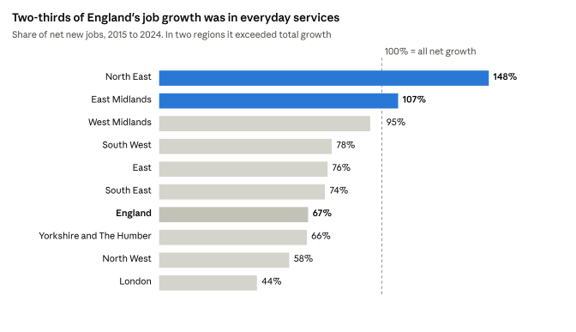
ONS BRES via Nomis, employment by SIC section, English regions 2015 and 2024; grouped per Buiatti, Duarte & Sáenz (2026)
In the North East and the East Midlands, everyday services added more jobs than the whole region gained. Every other part of those economies, taken together, shrank.
Tradable jobs tell a different story. By tradable, I mean sectors that mostly sell beyond the local area: manufacturing, information and communication, finance, and professional, scientific and technical services. They make up about a quarter of jobs in England, and that share barely moved between 2015 and 2024, from 24.6% to 24.7%.
• London took most of the growth. It added 377,000 of England's 638,000 new tradable jobs, 59% of the total.
• Elsewhere, everyday services grew five times faster. Outside London, tradable sectors added 261,000 jobs. Everyday services added 1.3 million.
• Some regions went backwards. In the North East, tradable employment fell by 25,000 jobs, or 10%, while everyday services added 67,000. In the South East it was flat. Manufacturing employment fell in most regions, including by 40,000 in the West Midlands.
Everyday services are growing everywhere, including where the tradable base is flat or shrinking. That growth is largely paid for by public spending, and by transfers from the parts of the country where tradable growth is happening, which on these figures means mainly London. It can sustain jobs, but it cannot sustain itself.
What we mean by everyday services
Everyday services are jobs where the service is a person's time. A care visit, a lesson, a hospital shift, a meal served, a bus journey, a case handled by a council officer: each needs someone to be there and do the work. You can make it better, but you cannot easily make it faster, automate it, or serve ten times as many people with the same staff.
That sets them apart from sectors such as finance or digital services, where technology and scale let each worker produce more over time. A bank can process millions more payments with fewer people. A care home cannot look after twice as many residents with the same team.
Crucially the value of everyday services is huge and we need repeat the debates about them, but to be clear everyday services should be understood in the following terms:
Everyday does not mean low-skill or low-value. Nurses, teachers and social workers are in this group. The label describes how the work grows, not what it is worth.
Jobs grow with need. Demand rises with population, ageing and public spending, so these sectors add jobs steadily in every part of the country.
They follow local income. Because output per worker grows slowly, these sectors do not raise a place's income on their own. Their growth depends on money earned elsewhere in the economy, through local spending or public funding.
Economists call these "nonprogressive" services, a term that goes back to William Baumol's work in the 1960s. It is accurate, but it sounds like a judgement, so I use "everyday services" here. The point is that we have grown these jobs, but we have also not addressed the way we fund a lot of them and as such we are creating a challenging loop around the costs of these services.
Why targets and incentives won't get us there
The roadmap ties Mayors' income to two tax bases. Both reward the proceeds of growth. Neither says much about how that growth is created.
Business rates grow with the amount and value of commercial property. A new distribution park or office scheme lifts the rates base, whatever happens to local jobs.
Income tax grows fastest where people earn most. Places that already have high-paid work gain most, and redistribution will then even some of that out.
The natural response is to add a better target: count tradable jobs, set a baseline, reward the places that beat it. But it repeats the mistake we already make. The National Audit Office found that the outcomes frameworks attached to Mayors' integrated settlements are shaped by national priorities and carry too many programme-level targets. One department proposed 44 indicators before cutting to 21 (NAO, June 2026).
The problem is not that we measure the wrong things. It is that our approach assumes growth can be planned and delivered, sector by sector, from the top down, and then monitored. Growth does not work like that. It comes from thousands of firms deciding to invest, hire and expand, and from people deciding to train, move jobs and progress.
New government guidance on developing place-based business cases, published on 28 October, asks for a more honest appraisal of a place as it is, rather than as its strategy hopes it might be (Guidance on developing place-based business cases). For most places, that honest starting point is the labour market they actually have: a small and slow-growing tradable base, and a large and growing share of everyday services.
What growth is for: why tradable jobs matter in the long run
The long-term case for tradable employment rests on a simple chain, Rice and Venables find that places specialising in tradable activities have higher earnings. Around two-thirds of that gap comes from the knock-on effects of tradable productivity on local jobs and wages, not just from tradable sectors paying more (Rice and Venables, 2023).
Tradable jobs bring money into a place. A firm that sells its products or services beyond the local area brings in income that would not otherwise be there.
That income creates demand for everyday services. People in those jobs spend locally, in shops, restaurants, gyms, childcare and personal services. Enrico Moretti's research on US cities found that each additional manufacturing job created about 1.6 local service jobs, each skilled tradable job about 2.5, and each high-tech job almost 5 (Moretti, 2010).
It also creates the tax base for public services. Higher-value tradable jobs generate the income tax, business rates and national revenue that pay for health, care and education. Under the roadmap, a growing share of that will stay local.
Better-funded public services create better everyday jobs. A health and care system that is properly paid for can offer better pay, hours and progression to the people who work in it.
Run the chain the other way and the problem is clear; growing everyday services without a growing tradable base means jobs that depend on money raised elsewhere. They meet real needs, but on their own they do not raise a place's income, and they leave care and health dependent on settlements set in Whitehall, and other private everyday services facing the challenge of increased wages costs but limited growth in local demand.
One effect of this is as funding is constrained, the firms react by reducing hours, using flexible employment and other means to spread that expenditure further. The effect is more employed, but on lower wages with a push to increase minimum wages which have their own impacts.
So the argument is not that everyday services matter less. It is that they follow growth rather than lead it. Without a growing tradable base, a place cannot fund the public services it needs, cannot offer enough work that pays, and gives people and firms little reason to invest in progression and growth across all sectors.
Growth is the outcome; the labour market is the means
Most regional growth strategies start with an ambition, such as a growth target, a list of priority sectors or a pipeline of projects, and work backwards to the skills and jobs they will need. I think we should turn that round.
Growth is what happens when firms can find and keep the people they need, when people have good reasons to progress, and when firms have the confidence to invest. Those are labour market questions. For a region's labour market to deliver growth, it has to do three things:
Make work pay. Jobs need enough pay and hours that work is worth taking and staying in. That matters most in everyday services and retail, where around four in ten jobs are part-time. But making work pay is not just about increasing minimum wages it is also about understanding the need to tackle wage compression in the middle.
Reward progression. People need clear routes from entry-level jobs into better ones, and to see a return when they train. This is more than supplyin skills, its about wages and again tackling wage compression in the middle - increasing income means increasing taxes, there has to be an incentive thats more than a margin per hour.
Give firms reasons to invest and grow. Firms expand when they are confident they can recruit, train and replace the expertise they lose as experienced staff leave or retire.
Policy cannot specify those needs from outside. Firms in the same sector differ in the skills they need, in the tasks their jobs involve, and in the expertise they must replace. A list of priority sectors cannot see those differences. Priority sectors should guide inward investment and spatial development, but the role of a Mayor is less to ‘plan growth’ and more to make the local labour market work: helping firms grow, helping people move into better jobs, and shifting the balance of employment towards tradable activity over time.
What this means in practice
Putting the labour market first means economic development needs one lead role, business development, and two supporting ones, business support and skills.
Do business development
Business development, meaning support for high-growth firms, exporters and inward investment, becomes the main job. At the moment it is usually measured by investment announced and floorspace built, which the new business rates incentives will reinforce. A better approach would:
focus on firms that trade beyond the local economy and target investment in growing the ones that actually matter rather than those that most align with the IS8. The Industrial Strategy is important and should shape policy but it should not be followed as a top-down plan of growth
value the jobs those firms create and sustain locally, and the local supply chains they build, not just the investment they announce. This means looking at the immediate needs of those tradable firms for vacancies but working with their broader sector on long-term labour need - not just skills gaps.
work with each firm on what it actually needs to grow, whether that is sites, finance, export routes or people, rather than offering a standard package through a growth hub.
Align business support and skills behind it
Business support then becomes about helping firms get better at running their businesses: the efficiency, effectiveness and resilience that keep every sector growing, or at least able to adapt as conditions change. It should focus on helping firms adopt technology and manage their resources and staff. It should also recognise that the care, transport, hospitality and local services firms that make a place work for the people who live and move there are part of the infrastructure tradable growth depends on.
Skills then serves two specific needs. The first is a supply of skilled people into the tradable sectors being developed. The second is upskilling and reskilling people in other sectors, in response to what firms there need.
This might sound like the system we have, but it is a much narrower offer. Apprenticeships, T Levels, V Levels and other qualification routes would be prioritised around the needs of business development, with only a few nationally mandated routes, such as those into regulated health professions.
Beyond that, bootcamps and other short courses would address skills gaps as they emerge, giving local provision the flexibility it needs. It would mean fewer, clearer options for young people at 16, 18 and 19, tied to where jobs are being created, so that more of them have a real job at the end of their route. A broader offer would then open up for people once they are in the labour market, when they and their employers know better what they need.
In short: business development to grow the tradable base, business support and skills aligned behind it, and a labour market that makes work pay and rewards progression.
Start with the labour market
Fiscal devolution will change how Mayors are funded, but incentives on their own will not rebalance the economy. Any job will count politically, and redistribution will even out the rewards. The reason to grow tradable employment is that it creates the wealth that sustains public services, the jobs that make work pay, and the reasons for people and firms to invest in their future.
If we want growth in every postcode, we should stop treating growth as a plan to be delivered and monitored, and start treating the labour market as the way we get there.
Notes on data and sources
Employment data: ONS Business Register and Employment Survey (BRES), open access via Nomis, employment by SIC 2007 section for the nine English regions, 2015 to 2024. England is the sum of the regions. Employment includes employees and working owners. ONS notes that BRES gives point-in-time estimates and is not designed for time-series analysis, and 2024 figures are provisional. Results for England were checked against three-year averages (2015 to 2017 and 2022 to 2024) and hold.
Tradable sectors: defined here as SIC sections C (manufacturing), J (information and communication), K (financial and insurance) and M (professional, scientific and technical). This is a section-level approximation: some activity in these sections serves only local markets, and some tradable activity, such as parts of wholesale and logistics, sits elsewhere.
Everyday services: C. Buiatti, J. B. Duarte and L. F. Sáenz (2026), Europe falling behind: Structural transformation and labor productivity growth differences between Europe and the U.S., Journal of International Economics 161. "Everyday services" here are the paper's nonprogressive services: transport, hospitality, real estate, public administration, education, health and social care, arts and other services.
Tradability and earnings: P. G. Rice and A. J. Venables (2023), Tradability, Productivity, and Regional Disparities: Theory and UK Evidence, University of Oxford Department of Economics Working Paper 996.
Local multipliers: E. Moretti (2010), Local Multipliers, American Economic Review: Papers & Proceedings 100. Estimates are for US cities.
Fiscal devolution: Budget 2026 fact sheet: Delivering for every region, GOV.UK, 28 October 2026.
Place-based business cases: Guidance on developing place-based business cases, GOV.UK.
Outcomes frameworks: Devolution in England: funding and accountability, National Audit Office, June 2026.